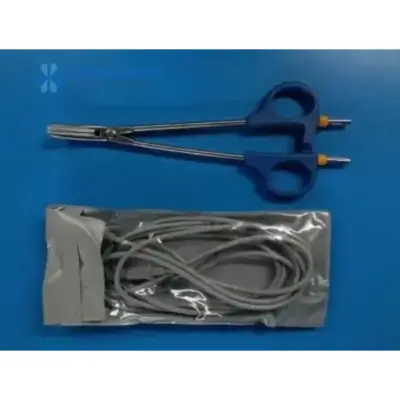
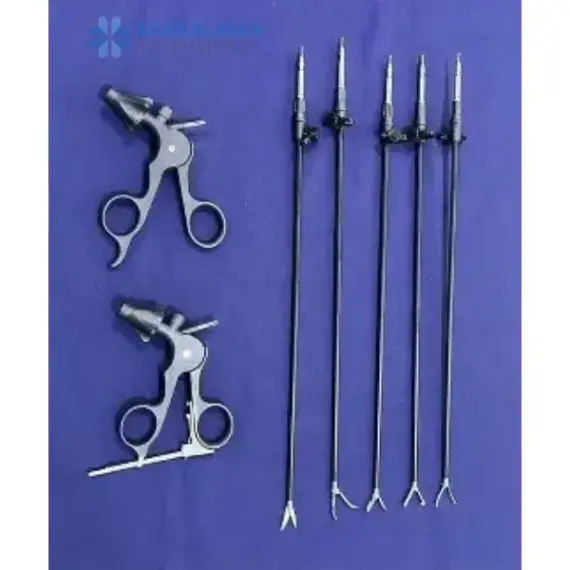
Laparoscopic Stone Holding Forceps
Free!
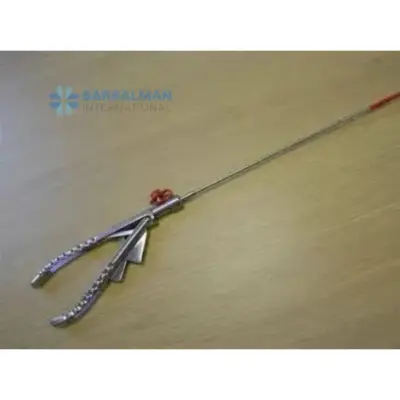
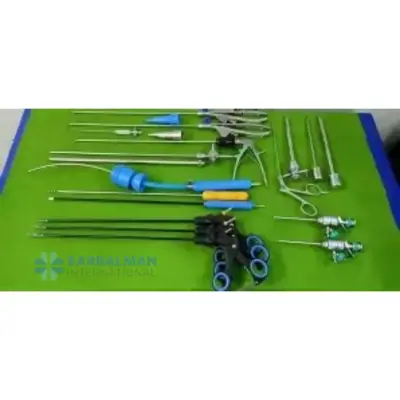
Laparoscopic stone holding forceps are precision instruments used to grasp and retrieve stones during minimally invasive surgery. Their long shaft, slim profile and specially serrated jaws provide a reliable, non-slip grip on gallstones or renal stones while protecting surrounding tissue. Ideal for biliary and urologic laparoscopy, they help prevent stone spillage, simplify extraction and support smoother, more efficient surgical procedures.
Description
Laparoscopic stone holding forceps are specialised minimally invasive instruments designed to grasp and retrieve stones and other hard fragments during laparoscopic surgery. Used through standard trocars, they allow the surgeon to securely hold gallstones, renal stones or foreign bodies and extract them through a small incision without losing control of the fragment inside the abdomen.
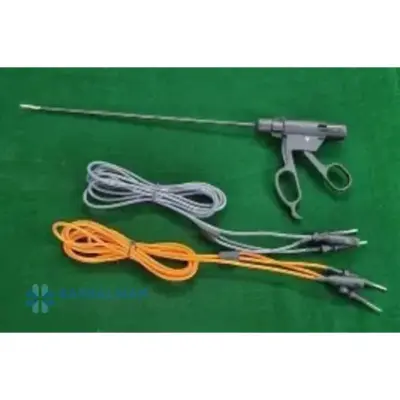
These forceps feature a long, insulated shaft with a slim profile that passes easily through 5 mm or 10 mm ports. At the distal end, the jaws are shaped and serrated to grip smooth, hard stones firmly while minimising trauma to surrounding tissue. A comfortable, scissors-style handle gives the surgeon precise, fingertip control, often with a ratchet mechanism to lock the jaws on the stone during extraction.
Key features and benefits:
-
Long laparoscopic shaft compatible with standard ports
-
Stone-specific jaw design for secure, non-slip grip
-
Atraumatic contours to protect delicate tissue
-
Ergonomic handle for stable, fatigue-free control
-
Robust construction suitable for repeated sterilisation
-
Useful in both elective and emergency procedures
Typical applications:
-
Laparoscopic cholecystectomy to grasp and remove gallstones
-
Laparoscopic management of common bile duct or renal stones
-
Urologic and general surgical procedures requiring retrieval of hard foreign material
Compared with standard laparoscopic graspers, stone holding forceps are engineered to handle heavy, smooth stones without chipping or losing them, reducing the risk of spillage and shortening operative time. For hospitals and surgical centres aiming to deliver safe, efficient minimally invasive care, these instruments are an essential part of the laparoscopic urology and biliary surgery set.