
Ventilator Circuit
Free!
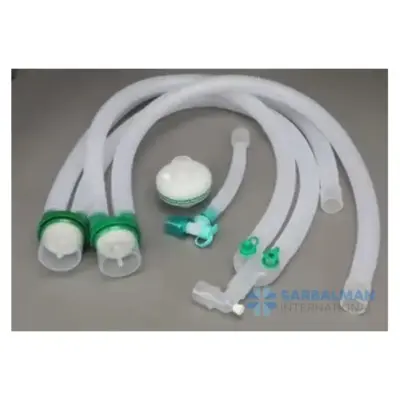
A ventilator circuit is a preconfigured breathing system that links a ventilator to the patient’s airway, delivering controlled breaths and removing exhaled gases. With kink-resistant tubing, standard connectors, and ports for filters or monitoring, it provides a stable, low-leak pathway for life-support ventilation. Ideal for ICUs, theatres, and emergency care, it simplifies setup, improves safety, and helps ensure accurate, dependable respiratory support.
Description
A ventilator circuit is a complete breathing system that connects the patient to an intensive care ventilator, anesthesia workstation, or transport ventilator. It typically consists of inspiratory and expiratory corrugated tubes, a Y-connector, patient elbow, monitoring lines, and ports for accessories such as filters, humidifiers, and nebulizers. Together, these components create a secure, low-resistance pathway that delivers precisely controlled breaths while safely removing exhaled gases. High-quality circuits are designed to minimize kinking, reduce dead space, and maintain stable pressures throughout the respiratory cycle.
Key benefits include:
-
Corrugated, kink-resistant tubing for reliable gas flow and flexible positioning
-
Standardized connectors compatible with most ICU and anesthesia ventilators
-
Smooth internal surfaces to support accurate tidal volume delivery
-
Integrated ports for pressure, capnography, and oxygen monitoring (model-dependent)
-
Options for use with filters or HME devices to support infection control and humidification
-
Clearly differentiated inspiratory and expiratory limbs to reduce setup errors
Ventilator circuits are widely used in ICUs, operating theatres, emergency departments, and during patient transport. Compared with improvised tubing or mismatched components, a dedicated ventilator circuit offers better integrity, fewer leaks, and easier assembly, which directly supports safer ventilation and more accurate machine readings. Many circuits are available in adult, pediatric, and neonatal configurations, allowing clinicians to choose the appropriate size and design for each patient group. By investing in dependable ventilator circuits, hospitals and clinics can streamline workflows, enhance patient safety, and support consistent, high-quality respiratory care.